
Samurai Sisters
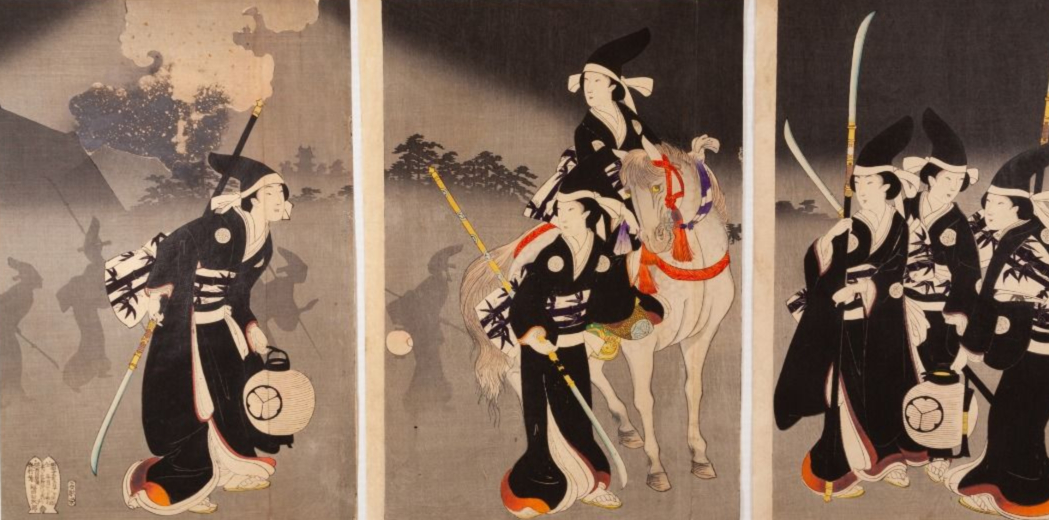
It was always going to be a treat – a day out in York, seeing Making Waves, the exhibition of Japanese woodblock prints at the York Museum and Gallery. I was expecting a feast of Hokusais and Hiroshiges and many more, and that’s what I got. (Who knew that Maidstone Museum had their very own original print of Hokusai’s The Great Wave, which they have generously loaned for this exhibition?)
What I wasn’t expecting was the fabulous print by Hashimoto Chikanobu (1838–1912) that is a recent acquisition for the gallery by its Friends: Evacuation of the Ladies depicts female samurais – resplendent in a uniform of black kimonos with bamboo-decorated obis – escorting women away from the Great Fire at Edo Castle in 1844. Women operating professionally in what I had thought was the all-male preserve of samurai? I had to know more. (NB: had I been decades younger and a manga/gaming fan, I probably would have known more already… )
‘Onna-musha’ – women who were members of the warrior class – were documented in Japan as early as the twelfth century. Thery were trained to use weapons to protect their households in time of war, but some fought alongside men as well. Later records also note the existence of female cavalry forces. Individual women have gone down in history for their valour, not least Tomoe Gozen: ‘… she was a warrior worth a thousand, ready to confront a demon or a god, mounted or on foot.’
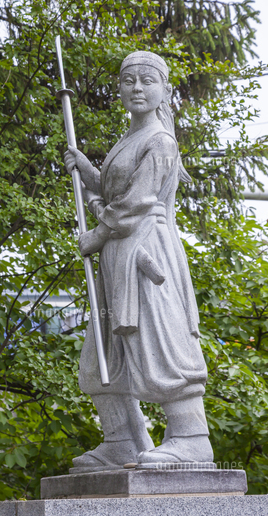
The weapon most commonly associated with onna-musha was the naginata, a long pole with a curved blade at the end. Its reach enabled women to compensate for their smaller stature. The statue of the shrine of the iconic onna-musha Nakano Takeko shows her wielding the weapon she excelled at using.
In a phenomenon that seems to be repeated at all times and in all places, onna-musha lost much of their influence from the seventeenth century onwards, and the political conservatism of the Edo period saw women of the upper echelons confined to the home and only allowed out when accompanied by a man. Onna-musha attempting to travel faced constant harassment at checkpoints.
But onna-musha didn’t go away. There were still training schools where they could train in the use of naginata and other weapons., so they were battle-ready when the Boshin War (sometimes known as the Japanese Civil War) broke out in 1968. Fighting alongside Takeko was another remarkable woman, Yamamoto Yae. Her father was a samurai and a gunnery instructor, and she herself became skilled in gunnery, which was highly unusual at this period. After her service in the Boshin War, she moved to Tokyo, where she taught at the Kyoto Women’s School. She married a former samurai, Joseph Hardy Neesima, who had lived in the US for ten years, and together they opened a school for girls. Their marriage of equals was a source of disapproval and controversy. (For a start, she was blatantlly disregarding the Article Four of her clan’s code: ‘The words of women and girls are to be utterly disregarded.’)
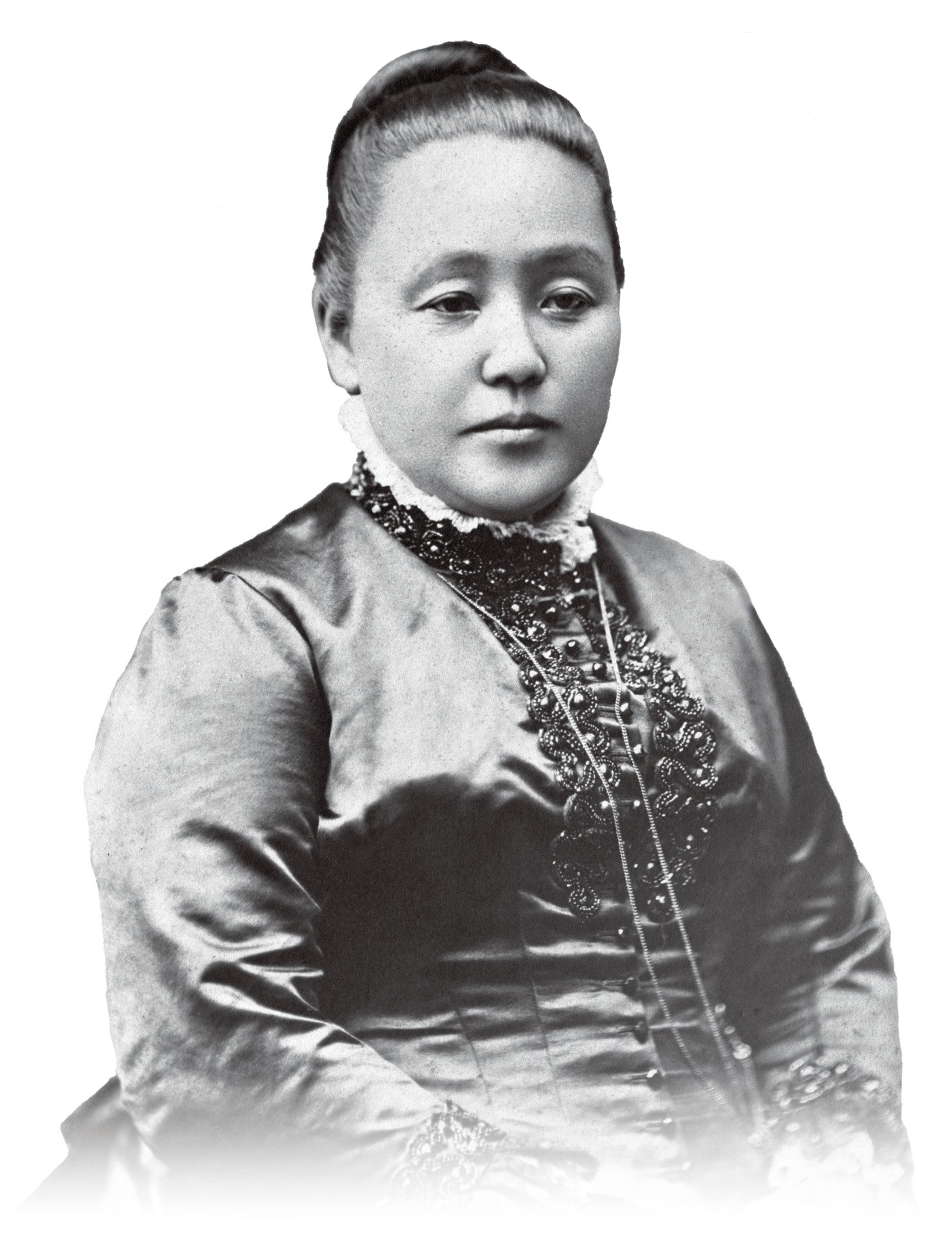
Following Neesima’s death early in 1890, Yae turned to nursing and became a member of the Japanese Red Cross. She joined the army in April 1890 and when the Sino-Japanese War she was stationed at Hiroshima, leading a team of forty nurses – and campaigning for greater recognition of the importance of the profession. After the war, she became a nursing instructor.
In 1894 she qualified as a tea master, entitled to perform the Japanese tea ceremony, and in 1896 she was granted a licence to practice Ikenobō (the oldest and largest school of ikebana) flower arrangement. All in all, a rather unusual professional journey. It seems to encompass my overriding (but perhaps ill-informed) impression of Japanese culture: a dizzying paradox of extreme refinement and delicacy as evidenced by its art, poetry and ceremonial, combined with an appetite for violence, as evidenced by the excesses of (male) samurai lawnessness and ultimately the atrocities of the Burma railway.
Making Waves is on at the York Museum and Gallery until 26 August