
Maeve Gilmore

I have lost count of how many years I have lived in south London, but it took an article in the London Review of Books to point me to an exhibition at an artists’ studio and gallery a mere 5-minute cycle ride away.
The artist featured is Maeve Gilmore (1917-1983), who was married to writer and artist Mervyn Peake. At this point in my blog I can hear a sharp intake of breath as Dame V casts her mind back to a particularly crazy episode in our lives, post ‘A’ level, when certain characters from Peake’s novels played a key role. One day I might even be brave enough to write about it in damesnet.
But back to Gilmore. In 1936 she met Peake on her first day at Westminster School of Art, where he taught, and they married a year later. Gilmore was an accomplished painter and sculptor and wrote several short stories. The couple had three children, but when he became ill she put her career on hold. After his death in 1968 she worked to conserve his legacy, completing the final volume of his Gormenghast trilogy, organising his letters and papers, liaising with biographers, academics and curators.
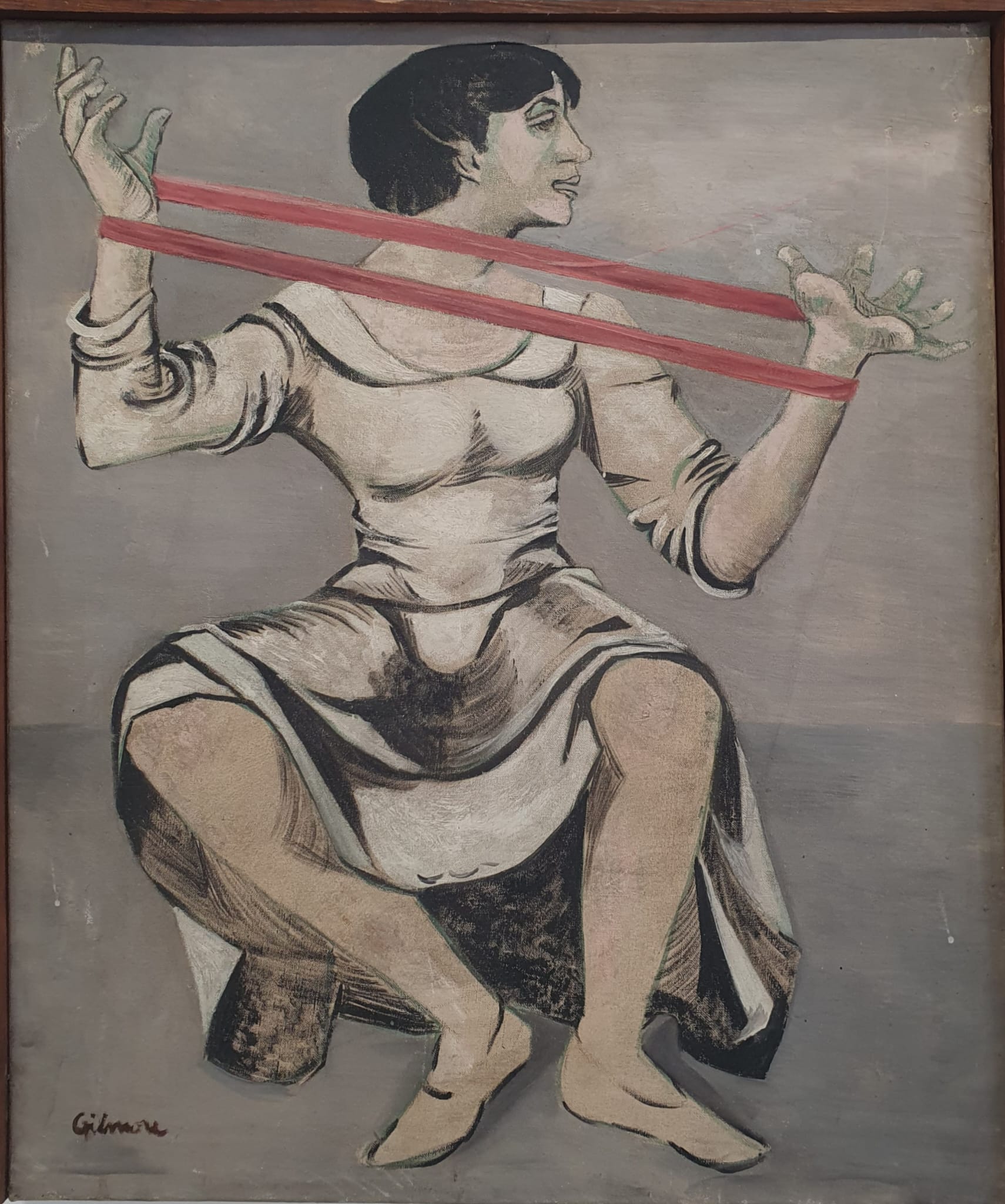
Gilmore did continue to paint whenever time allowed, noting: ‘I always seem to have been able to paint when there is intense life surrounding me, despite the eternal meals, the fights of one’s children, and the constant demands of domesticity.’
During her lifetime, Gilmore’s work was only rarely exhibited, but her granddaughter Christian Peake has an Instagram account dedicated to Gilmore’s art. The exhibition at Studio Voltaire in Clapham features 20 oil paintings in the vaulted space of a former Victorian chapel. Two self- portraits are uncompromising in their detail – her brows are furrowed, the eyes look tired. Yet what comes across is a strong character, elegant and determined.

Gilmore wrote an account of her life with Peake in A World Away, describing their somewhat chaotic time in various studio flats in London and houses in Kent, Surrey and Sark. The paintings feature family life in various settings; Gilmore’s two sons, Sebastian and Fabian, are present in many of them, in what might at first glance seem like an idyllic childhood. They have feather headdresses dating back to a time when it was not politically incorrect to play Cowboys and Indians. They are painted in athletic or gymnastic poses; the family cat appears in several of the pictures as do various objects from their homes.
The paintings are full of contrasts in terms of light and shade; they are at times dreamlike in composition and attitude, suggestive of an inner symbolic language. Colours are often muted and shaded yet manage to be vivid at the same time.

Viewed from both feminist and art historical perspectives, Gilmore’s work can be understood in a context that also includes artists such as Vanessa Bell and Winifred Knights, or the early British Surrealists Leonora Carrington, Eileen Agar and Ithell Colquhoun.
Gilmore was born in Brixton, less than a mile away from where Studio Voltaire is located. Last year I wrote a blog entitled ‘In front of every successful man’. It explored a few of the women whose self-sacrifice ensured the success of their husband or partner. In my view Gilmore belongs in this category; we have to be grateful to her granddaughter for ensuring that the name Maeve Gilmore is known for her own creativity and achievements, rather than as the wife of Mervyn Peake.
A fascinating article, Barbara. Certainly Maeve Gilmore shows her own creativity if these paintings are anything to go by.
Thanks for sharing!
Thanks Joyce!