
Where were the women?
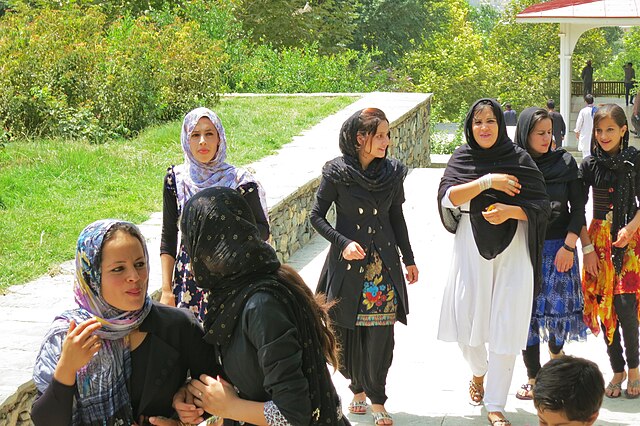
It is three years this month since the US and UK forces scrambled to leave Afghanistan, effectively admitting failure to change the regime to one that might have resembled a society based on justice and equality. History tells us that this was just the most recent failure of foreign intervention into Afghanistan.
It is the women and girls of Afghanistan who have been catapulted back into a world entirely run by men. Education for girls now stops at 11; women can no longer have any independent agency. They cannot study, work, gather together, sing, laugh and play. Any attempts at protest have met with a violent response; at first women would go onto the streets to protest, but the abuse, beating and imprisonment from the Taliban rulers has effectively stopped this.
Women are also banned from parks and gyms. It is hard to conceive of how many basic rights were stripped away in a matter of days.
I read an article about how one Afghan woman used to run a beauty parlour in the city. Beauty parlours were often the only source of income for households and they also provided one of the few places where women could meet and socialise outside the home as their lives became increasingly restricted once the Taliban took control.
These have now all been closed down by the Taliban. In order to make a living the woman has to work in secrecy from her home. She runs the risk of being discovered and then facing horrific consequences; her neighbours might tell on her, so she uses elaborate ruses to disguise her activity.
I recently read Rory Stewart’s book The Places in Between, an account of his solo walk across north-central Afghanistan in 2002. This was at the beginning of the war fought by the US and its allies inside Afghanistan after the September 11 attacks in 2001. As Stewart points out, he hardly saw any women as he travelled from village to village. Whatever you think about that 20-year conflict that ended so abruptly in 2021, the fact is that a generation of women grew up better educated and enjoying opportunities for work and independence that had not been available for their predecessors. Almost overnight these opportunities were snatched away, and it is hard to see how they will be reinstated.
In June the UN hosted meetings in Doha with the Taliban to discuss the future of Afghanistan. It was the first meeting between the Taliban and 22 other international envoys since the takeover of Kabul by the Taliban in 2021. There was one glaring issue that was not resolved: women were excluded from the talks as a precondition of the Taliban’s agreeing to any meeting at all. Apparently the Taliban had said that even the mention of the topic of women would result in them walking out of talks.
Civil society representatives were also excluded from the meeting. The UN Committee on the Elimination of Discrimination against women had called for ‘active and direct inclusion of women and girls in these discussions which pertain to the most serious crisis in women’s rights globally.’
Reader, the talks went ahead without any representation on behalf of Afghan women. I find it extremely difficult to understand how there could have been anything discussed in these meetings that would have benefited 50% of the country’s population. What on earth did they achieve?
A terrible situation for the women. I find it hard to imagine how they must feel. I wish there was something we could do to help.Good blog! We need reminding.
Thanks Stephanie. As you say, the worst bit is not being able to help in any obvious way.
Dame B
We do need reminding!
This situation is shocking , Barbara. How can we try to improve conditions for Afghan women if we do not have the facts? If we could of course.
Thanks for this. Another thought- provoking blog.
Thanks Joyce – an absolutely appalling situation.
Dame B