
Part of the Furniture
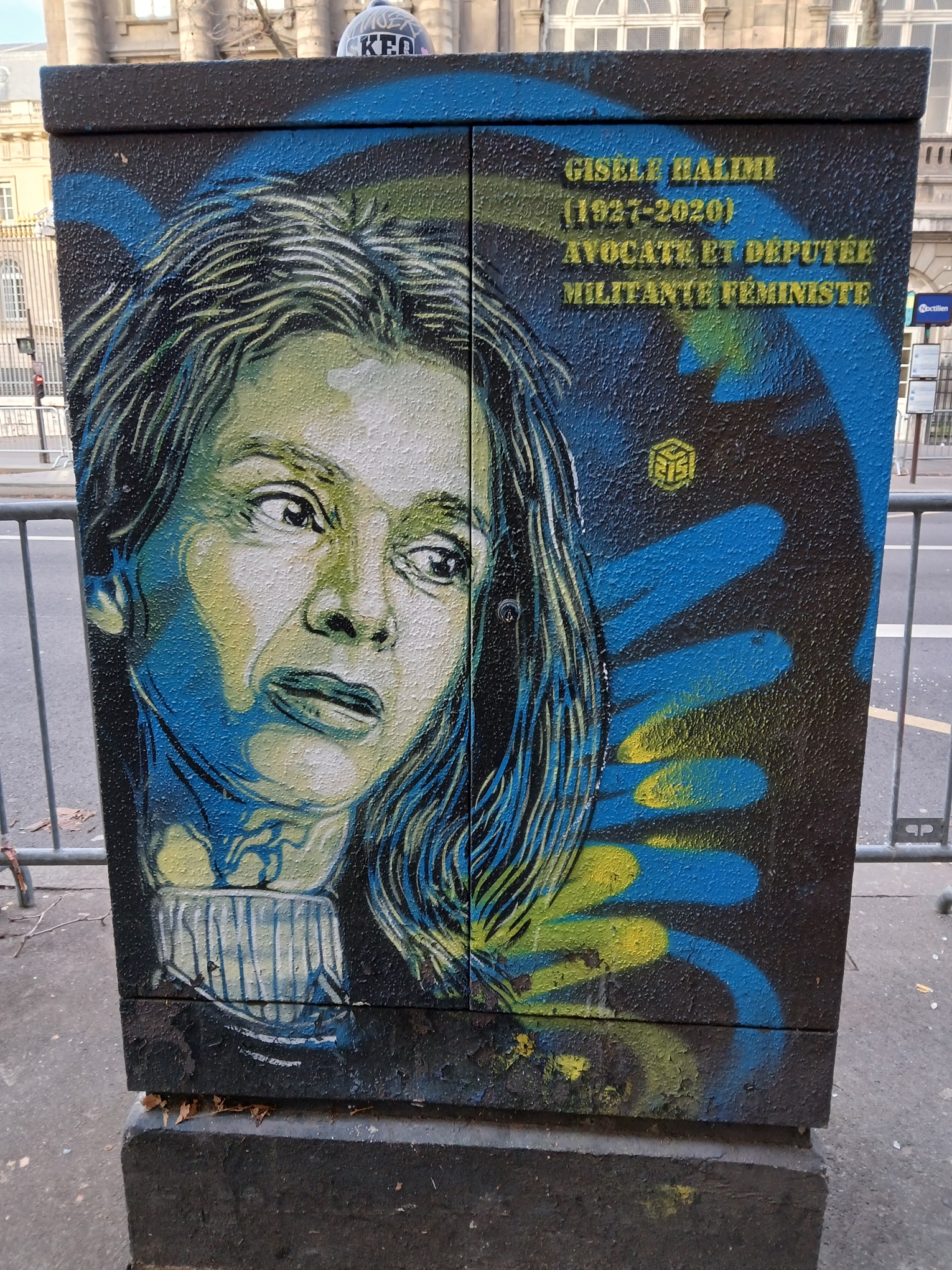
‘They order, said I, this matter better in France’, to quote from the opening of Laurence Sterne’s jolly 1768 novel A Sentimental Journey, and they certainly do when it comes to honouring pioneering feminists, whether it be through official statues, street names, or, as in this case, creatively decorated street furniture.
This portrait of Gisèle Halimi on a transformer in Paris stopped me in my tracks, and I had to find out more
She was born in Tunisia in 1927 to a Jewish Berber family – and when she was born, the parents concealed the fact of her birth for three weeks, since at that time the birth of a daughter was seen as a curse. As she grew up, Halimi could not help but notice the submissive role her mother occupied in the family, and this developed her feminist sensibilities early. At the age of twelve, she refused to wait on her brothers and went on a hunger strike against the expectation that she conform to the prevailing gender norms. At the age of fifteen she refused to enter into an arranged marriage to a wealthy oil trader many years her senior.
Insisting on ploughing her own furrow paid off. After school in Tunis, she did a degree in law and philosophy at the Sorbonne. She then spent eight years at the Tunis bar before joining the Paris bar. From then on her work pretty much tracks the progress of liberal causes: she defended an Algerian liberation activist raped and tortured by French soldiers and acted in the case of a seventeen-year-old girl accused of procuring an abortion after she had been raped. In 1967 she chaired a tribunal launched by Bertrand Russell and Jean-Paul Sartre to investigate US military action in Vietnam, and in 1971 she founded Choisir to campaign for contraception and abortion.
She was elected to France’s National Assembly in 1981, and became a delegate to UNESCO in 1987. In 1998 she co-founded ATTAC, an organisation promoting the creation of a transaction tax, initially on foreign exchange transactions. (This type of tax, sometimes known as a Tobin tax, is intended to counter the adverse consequences of globalisation and redress the balance between rich and poor nations. Despite the efforts of many high-profile politicians, including Gordon Brown and Hillary Clinton, worldwide adoption of such measures is still a distant prospect.)
Not a bad report card for one whose birth was such a cause for despair…
The artist we have to thank for Halimi’s portrait is Christian Guemy, known as C215. Could he be tempted to come here and decorate some of our junction boxes, ventilation panels, etc.? Would he get away with it? And who would we choose?
For a start, I’d like to see a big portrait of Barbara Castle, Minister of Transport from 1965 to 1968, perhaps on the very fabric of the London Transport building at St James’s Park. Then how about Ellen Wilkinson, Minister for Education in the immediate postwar period, on a pillar box in Jarrow, to acknowledge the part she played in the Jarrow March (among many other things)? And let’s not forget Jennie Lee, whose face should be emblazoned on every venue in Britain that receives Arts Council funding.
More suggestions, please, on a postcard!