
Gardens of Delight?
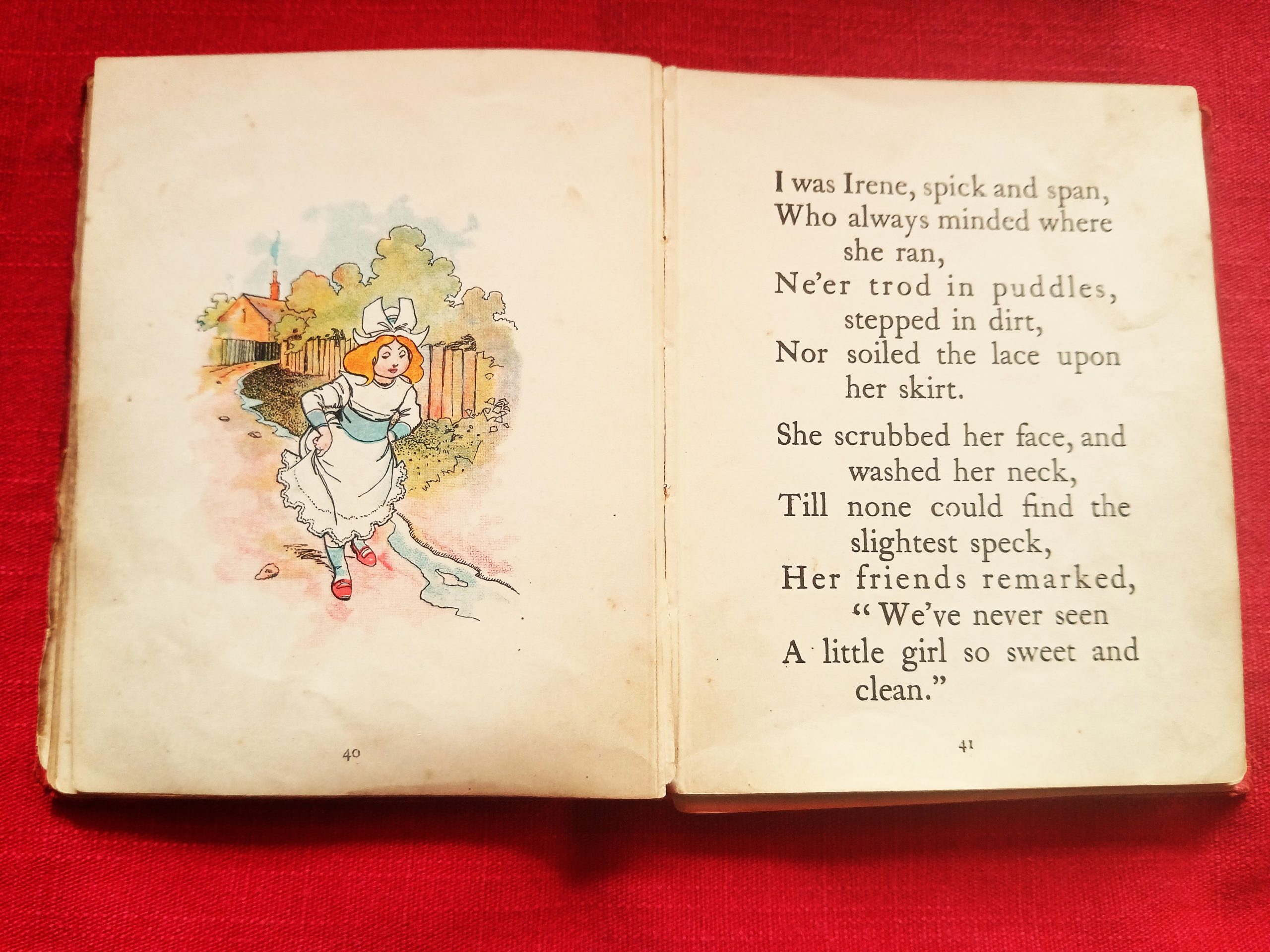
A recent trawl through the children’s picture books on offer at the local library made me reflect on the ones I’d grown up with, and the ones I’d read to my children.
My own childhood coincided with the heyday of Ladybird Books, whose dirndl-skirted mums, sunny skies and rigid gender roles I absorbed uncritically to the point where today’s parodies of those books have the whiff of blasphemy for me.
Some of the books I remember most vividly, though, are those that my grandfather had as a child, which were imbued with all the glamour of ancient artefacts, and which I was allowed to read on the rare occasions when I visited him. How I loved The Adventures of a Monkey on a Stick (spoiler: his adventures ended up being strikingly similar to Job’s), and marvelled at The Good Girls’ and Bad Boys’ Alphabet. The Calvinist message I took away from this latter book (and I fear many a hapless Victorian lad must have too) was that all boys were doomed: Vivian died from his tardiness, unable to escape the incoming tide; Ralph was burnt to death after playing with matches. Girls, on the other hand, had been socialised into full compliance and some were already possessed of qualities such as fearlessness and intelligence.
Likewise popular German picture book Struwwelpeter invoked a terrible predetermination, although here girls were also subject to fixities of habit that did for them in the end. These books did not waste time preaching their Victorian morality; they simply set out the appalling consequences of wilfulness, disobedience, lying, being idle, daydreaming, etc.
I now think of the world presented in the picture books I read to my children as something of a nirvana: somewhere where imagination, adventurousness and independence were encouraged and rewarded. Maurice Sendak’s Where the Wild Things Are (Max subdues umpteen fearful monsters before bedtime) is surely the apotheosis of this, but John Burningham’s The Shopping Basket comes a close second: Steven outwits a loutish bear, a pugnacious kangaroo, a hyperactive money and others on a simple errand to the shops (on his own!) to buy – cue refrain – ‘six eggs, five bananas, four apples, three oranges for the baby, two doughnuts and a packet of crisps for your tea’. In Burningham’s Come Away From the Water, Shirley, the child’s imagination runs riot at the beach, successfully shielding her from the stream of disheartening warnings from her parents about the perils of tar and cold water, and leaving her free to despatch pirates and find treasure.
In a different vein, Shirley Hughes excelled at presenting the world from a child’s point of view, portraying all the resourcefulness and bravery needed to negotiate the challenges that life in general and adults in particular throw at the pre-schooler.
But a glance at many of today’s picture books shows that morality, if not Victorian, has made a return. By way of example, many picture books preach kindness. There’s nothing wrong with kindness, of course, but when the vehicle for the message has been stripped of imagination and adventure so that the story becomes purely didactic, the thrill is gone. I recently came across a picture book peddling Marie Kondo decluttering . . .
Time for Shirley and Max to lead an insurrection!