
The Dictionary of Lost Words
Pip Williams, Penguin Random House, 2021
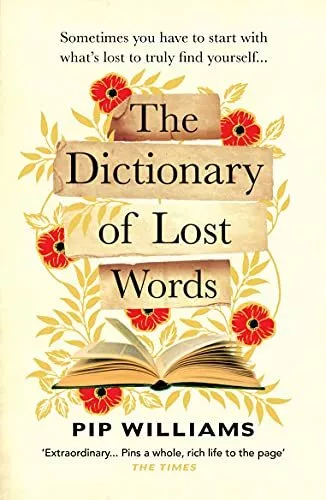
‘The first edition of the Oxford English Dictionary (OED) was a flawed and gendered text.’: Pip Williams’s judgement on this venerable institution had never occurred to me, but her intriguing recreation – dramatisation, almost – of the meticulous process of compiling it highlights the truth of this verdict.
It is 1887. In a draughty corrugated iron building in Oxford (the Scriptorium) a group of men sit at a large table marshalling hundreds of slips of paper. Under the table, quiet as a mouse, sits Esme, daughter of one of the lexicographers. A slip of paper bearing a word flutters down from above, unnoticed. Esme pockets it.
This is the innocuous start of a lifelong crusade to rescue words consigned to oblivion – usually deliberately. Thanks to her motherless status, Esme is allowed to accompany her father to work, and eventually, after some brief excursions into formal education, moves from dictionary dogsbody to lexicographer in her own right.
It is her relationship with Lizzie, both housemaid to the family of the OED’s editor, James Murray and de facto surrogate mother to Esme, that sets her on the path to questioning the criteria for the inclusion of words in the dictionary. She discovers that many words in common use do not feature in it as there are no printed citations for them. Thus begins her quest to capture the meanings of these elusive terms, complete with example sentences given by her sources. Slips bearing the words and their definitions and oral citations begin to pile up in an old chest under Lizzie’s bed.
As a young adult she visits Oxford market with Lizzie, and encounters the ‘C’ word for the first time. Naturally she checks the relevant volume of the OED and finds it missing. But she does find it among the discarded works stored in the Scriptorium, alongside evidence of heated discussion both for and against its inclusion: ‘It’s obscene!’, ‘The thing itself is not.’ Clearly the old white Victorian males got their way on this occasion.
The book is obviously a delight for a word nerd, and its evocation of both the physical labour and the intuitive craft of assembling the volumes of the OED is somehow enthralling. But as Esme’s life intersects with key historical moments – the gathering pressure from the suffrage movement, the emergence of the new woman, and the cataclysm of World War I, it ranges far beyond the pages of the OED, to examine these shifting currents, question changing mores and engage with the debates of the day – not least whether the more restrained campaigning of the suffragists will prove more effective than the guerilla tactics of the suffragettes.
My early misgivings about the novel had to do with the inevitable naivety – at times tending to tweeness? – of the very young narrator in the opening chapters, but as Esme grows and finds her distinctive voice, the reader can’t help but be drawn in.
The love story that emerges subtly and slowly is worth waiting for. It’s a real marriage of true minds, based on a shared commitment to honesty and equality – and a love of books.
To sum up, I simply can’t improve on Jacqueline Wilson’s verdict: ‘A brilliant book about women and words – tender, moving and profound.’
I couldn’t agree more! I loved this book . I could happily re-read it…I think I will!
Thanks Verity.
I loved this book!
You have inspired me to re-read it.
Thanks!
I can’t access Barbara’s link but I’ll keep trying.
Thanks – I think it’s one I’ll keep coming back to!
Barbara’s grappling with a new phone, which may explain link problems – but this is just an untechie guess!