
Absolutely Super
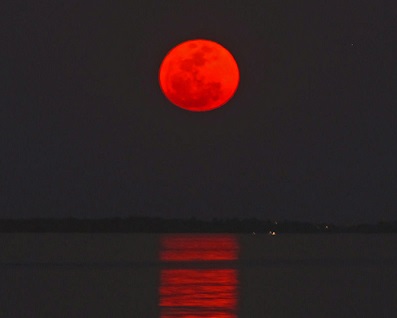
Super Moon Rising/Creative Commons/flickr
Mass global communication is an extraordinary thing, and for the time being I can only sing its praises. When natural disasters occur around the world emergency services are able to be mobilised and rushed to the precise spot as soon as possible, thanks to information feeds that are instantly available. We all saw what happened this summer as the aggressive attitudes to the ‘swarms’ of migrants flooding into Europe were gradually softened and then melted after the world saw the tragic picture of a young Syrian child drowned on a beach. The German motor industry is currently in uproar courtesy of some rather large porky pies promulgated by Volkswagen concerning levels of emissions, and it didn’t take long for the story to leave Germany’s borders and implicate other markets.
But for sheer beauty and a very different sort of shock and awe, I think this week’s super moon prompted a truly wonderful global response. What is it that so fascinates us about the moon, and why do we get so excited when it gets that little bit closer to the earth and seems to hang in the sky, just waiting to fall down to earth? Children are fascinated by the moon – we excitedly point it out to them as soon as they are of an age to be aware of it. When my daughter was little I used to sing to her at bedtime (I was desperate), and one of her all-time favourites was a line from Bob Dylan’s ‘I’ll be your baby tonight’, – ‘That big fat moon is gonna shine like a spoon, we’re gonna let it, you won’t regret it’.
The pictures of the super moon and eclipse from around the world were exquisite; it was called a ‘blood moon’ because of the reddish hue it took as the Earth’s shadow passed over it, and people shared their spectacular pictures from all over the world, so we could see just how it looked from so many different vantage points. I knew all about blue moons – but blood ones??
The moon never ceases to excite and inspire. President Kennedy declared in 1961 that men would reach the moon by the end of the decade – and on July 20 1969 the USA achieved this. Those of us who were around at the time watched the transmissions from the moon in astonishment – and I for one don’t believe the conspiracy theories which say the guys never got there.
The world of literature, science fiction, film, music and television is full of stories related to the moon. To pick just a very few: Lucien of Samosata, a Roman citizen who lived in Syria, wrote True Stories in the 2nd century AD, in which a band of adventurous heroes end up being lifted up onto the moon on a whirlwind. Jules Verne wrote From the Earth to the Moon in 1865. H G Wells followed this with his The First Men in the Moon in 1901. Robert Heinlein wrote numerous books about first voyages to and colonisation of the moon. Fritz Lang wrote and directed Woman in the Moon in 1929, and as a Lang fan I am determined to get to see this. Doctor Who has been to the moon on many occasions. We sing nursery rhymes about the moon to children, and there are countless video games involving the moon.
Damesnet readers are invited to send in their favourite moon picture/story/cultural example. In the meantime, Shine on Harvest Moon…
Although I revere Georges Melies as the founder of cinema, I really hate his film ‘Journey to the Moon’ because I can’t bear to see the poor old moon having a space rocket land in his eye.