
Cherry blossom and the English rose
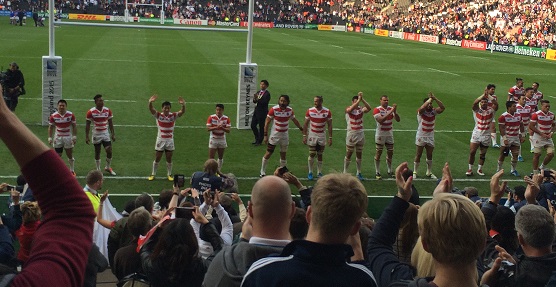
Japanese Rugby Team/Milton Keynes/October 2015
Much is made of the difference between football and rugby fans, but not so much of the players. So when the Cherry Blossoms (or the Brave Blossoms as they are increasingly being called) wandered round to each side of the ground at Milton Keynes after their win over Samoa and didn’t just wave at the crowd but bowed politely, too, they cemented their relationship with their British fanbase.
It’s strange how a love affair can start. As underdogs, their victory over Rugby World Cup Champions South Africa brought them into the limelight. Just a few short days later we commiserated as they faded against a rested Scottish team. On Saturday, however, they were back to their sparkling best against Samoa, playing to a crowd dressed as samurai warriors waving the Japanese flag.
They are so different to other teams, I said to the kind friend who’d given us a lift to the stadium. Well, yes, he agreed, before pointing out the numerous similarities between England and Japan. He’d lived there for 20 years, and cited the politeness, the weather, the family ties…the list went on. I’d never viewed Japan in this context at all, so decided to do a little digging.
They are two monarchic, somewhat eccentric, island states and we do, it seems, have over 400 years of shared history. In the 1600s Englishman William Adams was taken under the wing of shogun Tokagawa Ieyasu, helped the Japanese build their first Western-style ship, and sought closer trading links between the two countries. Sadly, the goods that made the crossing from England never quite made the grade: shabby wool, Cornish tin and cloves. Not, said Adams, “very vendible”. But the technology that transported them, well, that was a different matter.
Fast forward to 1859, when Aberdonian Thomas Glover arrived in Nagasaki. He, like Adams, won the confidence of the local samurai and helped the Japanese buy their first modern warship from Scotland (Aberdeen, where else?), establish its first shipbuilding company and first brewery, called Kirin. The moustache on the brand’s trademark dragon is said to be a homage to him. The Anglo-Japanese Alliance of 1902 cemented the relationship between the two empires until, post its termination in 1921, we saw the terrible consequence of Japan’s stampede through South-East Asia and the inevitable fightback.
Those 20 years of the alliance, however, saw elements of Japanese culture cross from one country to another. Zen Buddhism, for instance, which prompted Reginald Horace Blyth (a vegetarian and a pacifist from Essex) to write the idyosincratic Zen in English Literature and Oriental Classics in which he sought to convey what he felt were the intuitions and wisdom voiced in both Japanese and English classics.
So here we are in a (relatively) new millenium and we still, it appears, have much in common. There are the tangibles, like our navy and post office system, which Japan has copied, our thriving pop cultures, our faded monarchies, and our reputation for being a bit stand-offish. Designers like Paul Smith and retailers like Lush have gone down a storm over there, while our love affair with their technology and motor industry is well documented.
The politeness and modesty of Japan’s rugby team was also manifest in its fans, and it rubbed off on those from these shores who waved back at the players, and saluted them, too. So what if the English are out? Let’s hope the Cherry Blossoms stay in. At least they have taught us that there is more to the game than body mass, height and skullduggery.
Was there at the match, too. It was indeed such a lovely moment,finished off the match perfectly. Our Japanese flags fly high at home. We have only ever been to two Rugby World Cup games: one in 1999 at the Millennium Stadium and this one. Each time we have seen Japan. Always polite but this time round a truly talented team of exciting rugby players. I do hope they get through to the next stage, they deserve it.