
Bravo for The Beano
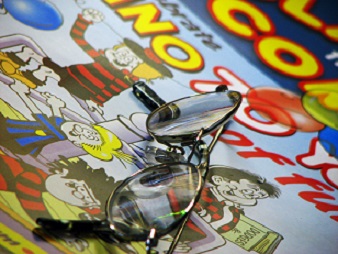
Reading matter/Sally Crossthwaite/flickr
For me The Beano has always had something about it of forbidden fruit – no, make that forbidden and utterly delicious cake stuffed full of E numbers. I was brought up on an earnest diet of edifying comics like Playhour, with its high-minded series about a travelling guinea pig called Gulliver (geddit?), and Look and Learn, with its – well, need I say more? It was all a bit ‘My parents kept me from children who were rough.’
Even its spongy paper and washed-out printing were alluring, signalling all the insouciance and anarchy to be found within its pages (which was more than you could say of Bunty, all of whose denizens seemed to go to private school).
The Beano set out its credentials right from the start: issue one had a whoopee mask giveaway (it looked like an ordinary eye mask, to be honest), and the front cover featured a small black boy in patched dungarees eating a slice of watermelon. Issue two came with a free packet of Sugar Button sweets.
Looking at the contents of some of the early editions, you can see evidence of a peculiarly British – or even English – obsession: bottoms. On the cover of the first issue an ostrich gets bitten on the bum because it hatched a crocodile egg. Two years later, Helpful Henry gets caned by teacher for helpfully wiping the board clean of a meticulously set out maths lesson. Shockingly, Keyhole Kate gets thrashed with an umbrella by a complete stranger because of her intrusive exploits.
Part of The Beano‘s appeal lies in its attention to detail. In the corners of the frames there is often an exuberant sideshow of commentary or ludicrous set-dressing. In the latest edition Calamity James heads off to the barber’s, where there is a poster advertising the No. 3 cut: yes, just three hairs standing up on the top of your head. One that has passed into our family’s sayings came from a strip in which the Bash Street Kids were struggling to take tea respectably, with a labelled arrow drawing our attention to one of the main ways of achieving this: ‘Note swanky little finger’.
It may now be printed in bright colours on glossy paper, and contain a World Wildlife Fund leaflet inviting readers to adopt a snow leopard, but there is still much that is un-PC in the modern Beano. Fatty is fat because he is greedy, Walter the Softy is still with us, and the football seniors in the Ball Boy strip all have walking sticks and not a tooth between them. Would we really want it any other way?
Like everyone else, The Beano has diversified into radio programmes, an online presence, and merchandising. (Their mugs are advertised against a backdrop of mayhem in famous cut-price supermarket Widl as Beano characters joust with baguettes, heads protected with colanders)
I’ve realised I have a very soft spot for The Beano. Parking wars are raging in our street at the moment, with a large and ancient camper van being plonked outside various houses for months at a time. It is tatty, rusty and lichen-covered, and looks like the lair of a serial killer, or (I am told) something out of Breaking Bad. With my ‘disgusted of Tunbridge Wells’ hat on, I’d even go so far as to describe it as an eyesore. But it came back from a half-term trip with a copy of The Beano on the dashboard, and – briefly – all was forgiven.