
Not a Plum Job
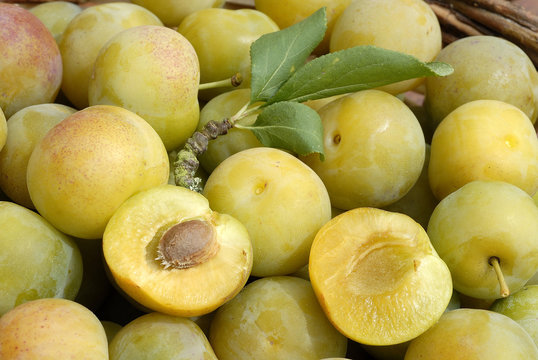
Why is it that the only place I’ve been able to find gooseberries this year is the Polish shop? And what has happened to all the greengages? My grumbly old-person’s theory is that they don’t look florid and luscious enough to have shelf appeal so supermarkets no longer stock them.
Thankfully the French have not fallen out of love with them, so I took every opportunity to gorge on them while on holiday. There they call them ‘reine claudes’, and as I bit into yet another ambrosial fruit, it occurred to me to wonder who this Queen Claude was.
Thank heavens for Wikipedia! I discovered that the Queen Claude they are named for had lived anything but a long and illustrious life: she died at the age of 25. Claude was the daughter of Louis XII of France, and at the age of 14 was married to her cousin, who was to become Francis I, with the main aim of keeping Brittany united with the French crown, since Claude was Duchess of Brittany in her own right.

Her father died shortly after this marriage, meaning that Claude became Queen of France alongside Francis at the age of 15. It’s hardly surprising she was no match for the powerhouse dames at court: her mother-in-law, the politically astute Louise of Savoy, and her sister-in-law, the literary lioness Queen Margaret of Angoulème, whose work Mirror of the Sinful Soul, may well have had an influence on the Reformation in Britain. According to the historian Brantôme ‘madame the Regent [Louise of Savoy] bullied her constantly.’
Which can’t have been much fun, especially as Claude was pregnant for most of the last ten years of her life. Those of her children who survived into adulthood took their place among the titled heads of Europe: Henry II, King of France; Madeleine, Queen of Scots, who died six months after marrying James V of Scotland; two dukes of Brittany and a duchess of Berry. Claude certainly confounded the critics who predicted she would not survive her first pregnancy.
Claude numbered among her household Anne Boleyn, in happier days, who may have acted as interpreter when English visitors came to the court.
The image of Claude reproduced here shows an austere-looking woman, plainly dressed, but by no means ugly. Brantôme and his contemporaries beg to differ: she was apparently short and suffered from scoliosis, a curvature of the spine that gave her a hunched back. Her perpetual state of pregnancy made it seem as if she was fat, which drew mockery. She also limped and had a squint.
God certainly did nothing to reward Claude’s piety. Brantôme tells us that ‘the king, her husband, gave her the pox, which shortened her days.’
So a life that was as ‘nasty, brutish and short’ as any in that period, despite her exalted status. It won’t make any difference to her now, but I’ve made a resolution to pay secret homage to her whenever I bite into one of her heavenly fruits.