
Queen of the Wild Frontier
Alan Hyde
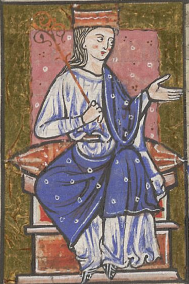
Penny Mordaunt’s recent swashbuckling appearance at the King’s coronation, when, as Lord President of the Privy Council, she held aloft the heavy ceremonial sword of state for nearly an hour, surprised and impressed many observers. She was likened to a warrior princess or Wonder Woman or Boudica, but few people, as far as I’m aware, compared her to Aethelflaed, England’s other great warrior queen. The forgotten one.
Aethelflaed came from good stock. Her mother, Ealhswith, was a Mercian noblewoman and her father was Alfred the Great, King of Wessex. She was born in about 870, at a time when England existed as four Anglo-Saxon kingdoms: Wessex, Northumbria, Mercia and East Anglia. The boundaries of English kingdoms had been fought over for centuries and were ever-changing. Those that existed in the ninth century represented the final configuration of what had once been a much larger division of territory between a greater number of Kingdoms and sub-Kingdoms. This period of internecine conflict was brought to an end in the ninth century by invaders from Denmark and other parts of Scandinavia: the fearsome Vikings. They arrived in force in 865 and embarked on a series of campaigns against the Anglo-Saxons. Northumbria and East Anglia were soon overrun. By 874 the Great Heathen Army, as the Anglo-Saxon Chronicle termed them, had taken the eastern regions of Mercia as well, leaving Wessex on its own, the last of the four Kingdoms attempting to resist the Viking advance. Years of skirmishing followed, but Wessex held out and eventually overcame the invaders at the Battle of Edington in 878.
It was a decisive victory. The defeated Vikings returned to their conquered lands in the east, and Alfred made plans to establish himself as the natural leader of all Anglo-Saxons. In his own Kingdom of Wessex he built defensive fortifications and established a navy. To strengthen his hand, he arranged a marriage between his daughter, Aethelflaed, and Aethelred, a Mercian ealdorman who was governor of what remained of Anglo-Saxon Mercia and to whom Alfred had recently entrusted the defence of London.
In the early years of their marriage Aethelred and Aethelflaed, who was probably still a teenager, had their first and only child, a girl they named Aelfwynn. According to the twelfth-century historian, William of Malmesbury, Aetheflaed’s experience of childbirth was so traumatic that ‘she ever afterwards refused the embraces of her husband’. Aethelred and Aethelflaed remained strong, however. They made plans to resist further Viking raids by rebuilding and fortifying key strategic towns such as Tamworth, Stafford and Warwick, and also set about restoring Mercia to its position at the spiritual and intellectual centre of the Anglo-Saxon Kingdoms. They refounded churches and supported the growth of Mercian monastic communities. Aethelred was known as Lord of the Mercians rather than King, but it seems that Alfred, having placed his daughter at Aethelred’s side, largely left him alone to rule, though no doubt with Aethelflaed watching over his shoulder.
On Alfred’s death in 899, Aetheflaed’s brother, Edward the Elder, assumed the throne of Wessex. In alliance with Edward, Aethelred and Aethelflaed were to embark on what would be a lifelong campaign to take back Mercian lands lost to the Vikings. Edward operated in the East while the Mercians moved north. As they did so, slowly but surely reclaiming lost territory, Aethelflaed’s skills in strategy and military leadership, no doubt learned in the Wessex camp during the long years of war, came to the fore. Crucially, she employed her father’s tactic of leaving protective fortresses behind to hinder invading armies. Chester and Manchester were among the towns she fortified. In 910 a combined army from Mercia, under Aethelflaed’s command, and Wessex, under Edward’s, defeated a major Viking force at the Battle of Tettenhall, providing a path for further gains in the Midlands and East Anglia.
During this period, Aethelred’s health began to decline and it is likely that Aethelflaed was de facto governor of Mercia for some time before he died in 911. Even so, her succession as ruler of Mercia was extraordinary. No woman had ever ruled an Anglo-Saxon Kingdom before. It is testament to the high regard in which Aethelflaed was held that her accession as ‘Lady of the Mercians’ was smooth and apparently uncontested.
The alliance between brother and sister continued after Aethelred’s death. Edward and Aethelflaed shared their father’s vision of a united England. They understood that the old Anglo-Saxon Kingdoms would have difficulty in resisting further Viking incursions on their own. In 917, after a further period of fortification and a successful campaign in Wales, Aethelflaed took her army to Derby, one of the five principal towns of Danish Mercia, and recaptured it in arguably her greatest victory. Leicester followed in 918, surrendering without a fight. By this time Edward had retaken all of East Anglia. When Aethelflaed reached the River Humber, the Viking-held city of York also pledged allegiance to her.
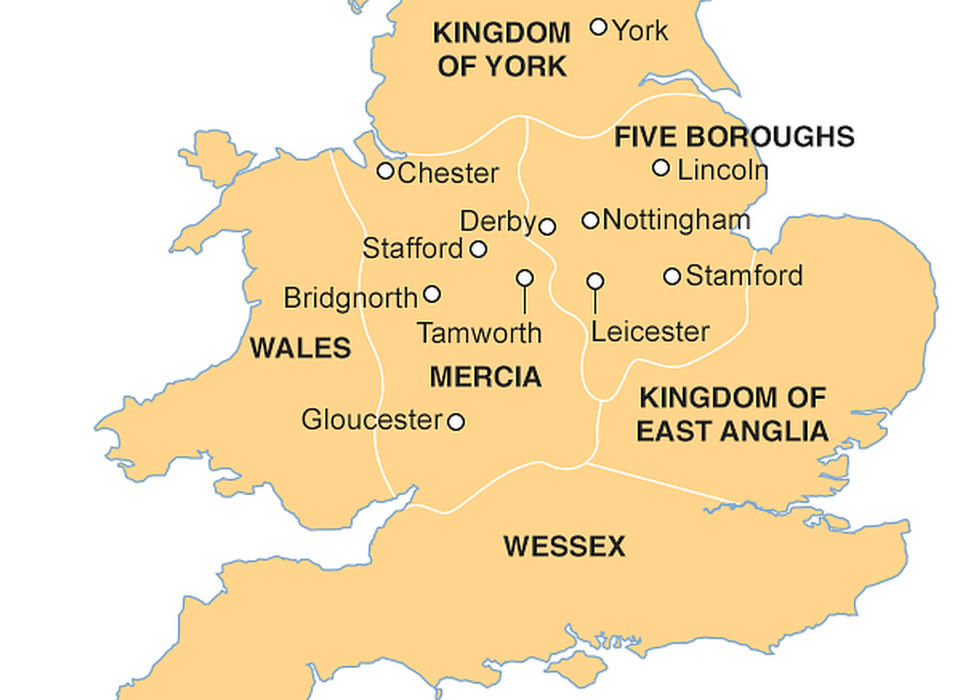
Sadly, before she was able to enter York, Aethelflaed was taken ill. She died in Tamworth on 12 June 918. Her body was taken to Gloucester, where she was buried in St Oswald’s Priory beside her husband and the remains of St Oswald. Aethelflaed was succeeded by her daughter, Aelfwynn, but Edward, conscious of his father’s ambition to create a united Anglo-Saxon Kingdom and possibly concerned that his niece did not have the same qualities as his sister, quickly took control of Mercia himself. Aelfwynn was taken to Wessex where she lived the rest of her life in a convent. A few months later Edward completed the reconquest of Mercia.
For a long time after her death Aethelflaed was revered as a great ruler who made a vital contribution to the defeat of the Danes. To later ages she was as iconic a figure as Elizabeth I became nearly seven centuries later. To William of Malmesbury she was not just a powerful ally of Edward’s but ‘a woman of enlarged soul’. However, over the years, her exploits and unique place in English history have faded from memory and today her name goes largely unrecognised. It is only in modern-day Mercia that she is given due regard and remains an honoured figure. In Tamworth, where she died, special celebrations took place in 2018 on the eleven hundredth anniversary of her passing, when a six-metre high statue of her was unveiled, and an Aelsfest weekend is held each year to celebrate the town’s Saxon past and especially its own warrior Queen.
This article is informative but with an easy style that engages the reader. I’m now inspired to find out more about this most remarkable woman.
Many thanks Alan.
Comment Great story thank you. How do we pronounce her name?
Apparently her name can also be spelled Ethelfleda or Aelfled, so the Ae seems to be pronounced as if it were a ‘E’ as in egg.
But I may be wrong!
Dame B