
Angelica Kauffman, Royal Academy, till 30 June

Angelica Kauffman (1741–1807) was a thoroughly modern woman: having enjoyed great success with her portraits of British Grand Tourists in Florence, she moved to London at the age of 25 and set up a studio there.
Two years later, she was one of only two female founding members of the Royal Academy (the other being Mary Moser). None of it was easy, though. To her talent, she had to add charm and congeniality to attract commissions, which laid her open to gossip and malicious press coverage, and sheer hard work.
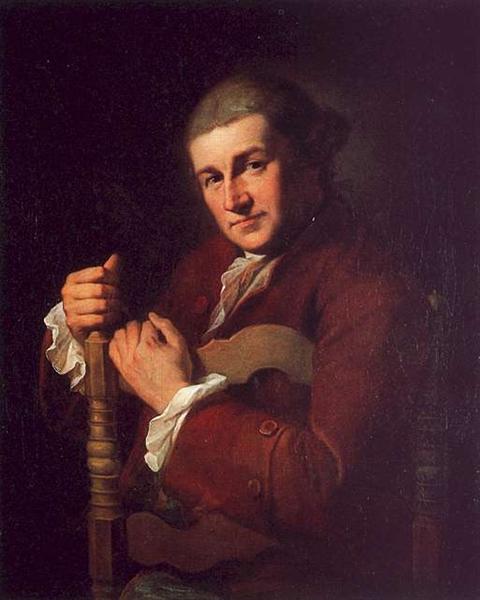
Evidence of her talent is everywhere in this exhibition. Her portraits have an immediacy that stops you in your tracks. Her portrait of her mentor, art historian Johann Joachim Winckelmann is compelling – warm, informal, capturing his sensitive gravity. By contrast her portrait of actor David Garrick gives us a more mercurial personality. Though the legend next to the picture notes the relaxed pose as he twists in his chair and how this seems to suggest a glimpse into the real man behind the performer, I disagree. Ask any visitor to the exhibition which is the portrait of the actor, and I bet they would lead you straight to this one. The easy confidence, the glint of humour – all point to a man whose private persona is as studied as his public one.
Kauffmann was not just good at faces, though. Her skill shines out in many ways: her handling of fabrics and textures, for example. You are left in no doubt that the swathe of fabric adorning her in the Self-portrait as the Muse of Painting is two-tone silk taffeta, with deep purple and tawny shades cascading over her white dress.
Her narrative paintings are ambitious groupings on grand themes, but perhaps the most appealing of these is on a more personal subject: Self-Portrait at the Crossroads between the Arts of Music and Painting. A talented singer, she could have taken up opera as a career, but a priest warned her off: the world of opera was filled with ‘seedy people’, apparently. In her painting, Music is imploring her to stay, but while Kauffman looks at her kindly and presses her hand consolingly, her body is set to leave in the direction that Painting points out for her.
The series of roundels she painted for the ceiling of Somerset House illuminate the depth of her expertise, focusing on the four strands of artistic creation: design, composition, invention, colour. Design and Composition are on display here. Design is a self-portrait of Kauffman as she studies and sketches a torso from antiquity. The intensity of her gaze signals the seriousness of her enterprise and her commitment to her art. In Composition, compass in hand, she is lost in thought, a chess set by her side. How better to represent the myriad thought processes, decisions, and revisions the artist sifts through during the creation of a work?
But in some ways, the most remarkable painting in this exhibition is not one by Kauffmann. It is Richard Samuel’s Portraits in the Characters of the Muses at the Temple of Apollo, of nine women outstanding in their age, among them Kauffman seated at her easel. There was only one other woman I’d heard of: Elizabeth Montagu, leader of the Bluestocking Society. Once again, where have, say, Hannah More or Anna Letitia Barbauld been all this time?
The answer lies in the picture that hangs next door: Zoffany’s crowded group portrait of the thirty-six artists who were founding members of the Royal Academy. They are all here: Sir Joshua Reynolds, Nollekens, Richard Cosway and the gang, milling around a studio with a couple of nameless nude male models. Where are Angelica Kauffman and Mary Moser? Up on the wall in portrait form – two-dimensional, silent, immobile…