
Documenting Domesticity
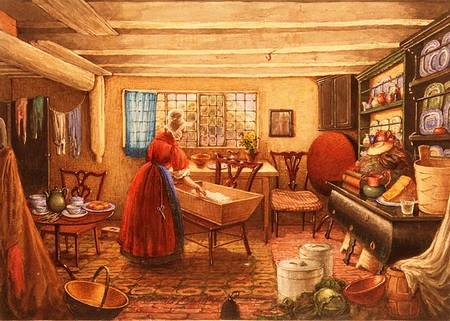
Another day, another undiscovered dame… The painter Mary Ellen Best (1809–91) should surely have taken her place in the pantheon of artists who have placed domestic interiors centre stage, such as Mary Cassat and Gwen John.
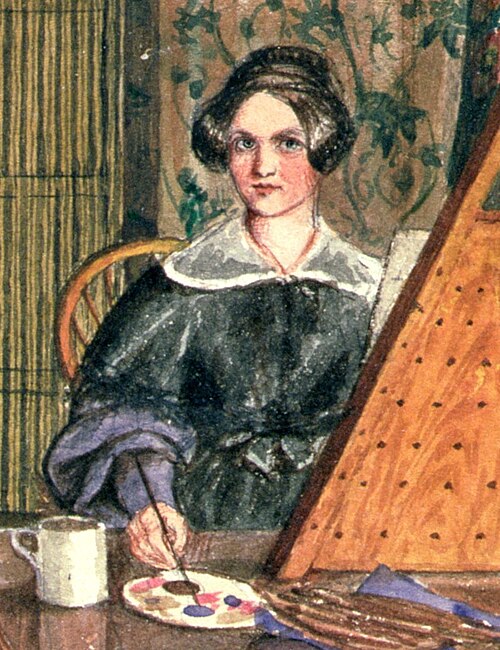
Born several decades earlier than these two, Best received the formal art training available to genteel girls in the 19th century. Despite the early death of her father, the provision he made for his widow and daughters allowed the girls to attend good schools. Best received art instruction from George Haugh, who exhibited regularly at the Royal Academy; illustrator Thomas Hofland; and perhaps even from Amelia Long, Lady Farnborough, a talented watercolourist renowned for her landscapes.
She set herself up as a semi-professional artist as soon as she left school, getting portrait commissions and selling her paintings for reasonable prices. At the same time, she continued with her studies: she visited country houses close to her home town of York to view the Old Masters that they contained – Castle Howard was a particular source of treasures. In fine weather she went sketching in the surrounding countryside. Her book of ‘Art and Artists’ was a constant companion – she even drilled her hapless two-year-old nephew Hugh into knowing the name of every artist featured in it.
Best’s mother was happy to accompany her on tours that would give her access to further-flung great houses and new surroundings. A three-month tour of North Wales provided plenty of material, both interiors and landscapes. In 1834, it was time to go to ’the Continent’. Best and her mother boarded a ship bound for Holland then travelled on to Frankfurt, rather than heading to Italy, which was the usual destination for tourists with artistic aspirations.
Best found plenty to keep her in Frankfurt: congenial neighbours, a commission to paint the Bavarian ambassador and his family, and the fabulous collection of Old masters at the Städel Institute, which had only opened in the previous year. She also had a chance to meet several luminaries of the German cultural scene at the time, including Mendelssohn, Clara Schumann, and Caspar David Friedrich, whose inspiration is clearly visible in some of Best’s works.
Mother and daughter returned to England in August 1835 as Best’s grandmother was gravely ill. She died the following month, leaving Ellen independently wealthy, so her need to exhibit and secure commissions evaporated. She continued to paint until 1860, though more for private consumption than public sale.
It was on a return trip to Frankfurt that she met her husband, Anthony, a schoolteacher of modest means whom Best’s family and friends seem rather to have looked down on. But Best was nearly thirty, knew her own mind, and – crucially – had money, so it didn’t matter what they thought. The pair settled in Germany, and Best’s pictures show Anthony to be a devoted father, far more engaged in his children’s activities than most fathers of the time.
Best’s independence is perhaps the key to her painting. She painted what she felt like painting, and she was insatiably curious about how people lived. Her pictures provide a meticulous insight into the domestic lives of all ranks. The level of detail in her interiors makes them in effect invaluable social history, illuminating the subtle differences in furnishings and domestic comforts generated by varying degrees of wealth. At the same time her portraits are vivid and personal, and her still lifes warm and vibrant.
How shortsighted of Sotheby’s to declare her work ‘unsaleable’. It took art critic and curator Howard Rutkowski to point out to them what a valuable record of domestic life Best’s output constituted for their worth to be appreciated, followed up by the admirable scholarship of Caroline Davidson in her book The World of Mary Ellen Best. As many of the works come from albums that have been broken up and the contents dispersed, who knows? There may be more out there…
Thanks for an intriguing insight into yet another overlooked artist. I’m inspired to find out more…!
Thanks!