
Damely Derring-do
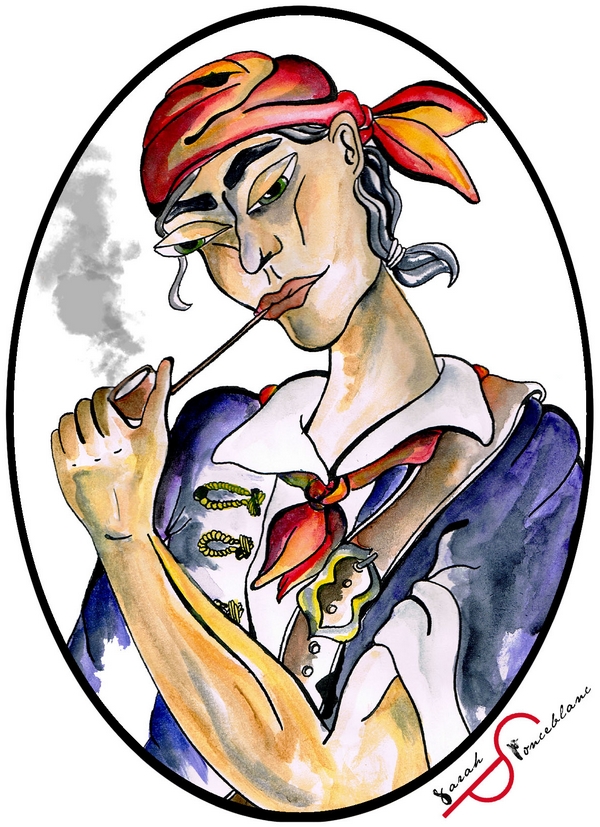
You wouldn’t want to have been Louise Antonini. The daughter of Corsican freedom fighters, she found herself completely alone at the age of ten, when her father died on the long, cold trek from the maquis country of France to Brittany. The family had been hiding out since the defeat of the Corsican nationalists in 1769, but when Louise’s mother died her father, Pierre, decided to flee to England. Thankfully, he also decided to dress Louise as a boy for the journey north – that was probably the making of her.
Somehow Louise made it to Brittany and managed to find her mother’s relatives, who took her in. There followed nine years of grinding poverty, leavened only by the sight of the tall ships coming and going in the port, and the travellers’ tales she heard, which held out the possibility of a new life.
On 23 May she took her chance. When the brig Revenge set sail from Lorient, Louise, disguised as a sailor, was on the bridge, helping to steer a course out of the harbour, with the name of its exotic destination ringing in her ears: Madagascar…
She never made it: the Revenge was wrecked and Louise found herself sailing back to Lorient on a cargo ship. She set about finding another ship, but it wasn’t easy. In her absence a change of legislation had put an end to the whole corsair enterprise, which had allowed French ships to attack the merchant ships of any country France was at war with and confiscate their cargo – with all mariners getting a share of the plunder. But the English fleet began to gain the upper hand on the trade routes, so the legislation was reversed. Louise seized the opportunity and enrolled on the frigate Cornélie, bound for the Antilles.
It was on the homeward journey some years later that the lookout on Louise’s ship spotted an English cargo ship, apparently unarmed and ripe for the picking. As they approached it, concealed cannon hatches sprung open and the crew swarmed onto the bridge. They had been tricked: it was a warship disguised as a merchantman.
Louise and her companions found themselves headed for one of Portsmouth’s infamous prison hulks, whose conditions were unspeakable. She managed to change into her prison garb undetected, but she was never able to sleep naked in the stifling heat below deck, as many of her companions did. The food was revolting: on high days and holidays a kind of slop in which, if you were lucky, you might detect a morsel of onion or even meat. On low days it was two potatoes and a piece of increasingly rotten kipper. And then there were the vermin…
By an amazing stroke of luck, Louse only had to endure eighteen months in this hell-hole. She was included in a prisoner exchange that saw two thousand French mariners returned to their homeland. Once home she was entitled to two month’s pay and a period of R & R, the only snag being that this was subject to medical examination. She was granted the money and leave, but kicked out of the navy.
Undaunted, she went off to join an infantry brigade, taking part in the siege of Maastricht in 1793. The foot soldiers were evidently more eagle-eyed than the sailor: Louise was unmasked and expelled in the middle of a campaign, but not without a monetary reward to recognise her service.
Civvy street was not for her, though. She headed to Bayonne, where she was not known, to rejoin the army. She moved up through the ranks, becoming a corporal, then a sergeant at the age of 40, when her luck ran out again. She was wounded in an engagement at the Battle of Evora (1808), and the surgeon who treated her could not fail to notice she was a she. Now she was out for good.
With nothing to do and nowhere to go, she turned to Captain Le Guen, a former comrade. It was he who had helped her find her sea legs, and they had kept in touch. He was a widower with five children, and took her on as his housekeeper. Whatever the nature of their subsequent relationship, she had found a home, and she devoted herself to it as ardently as she had to warfare in her previous life – to the point where her former major general petitioned for a pension for her when, at 66, she found herself alone again, Le Guen having died and his children left home.
Louise died at the age of 90, in a hospice in Nantes.