
Juana Azurduy (1780–1862)
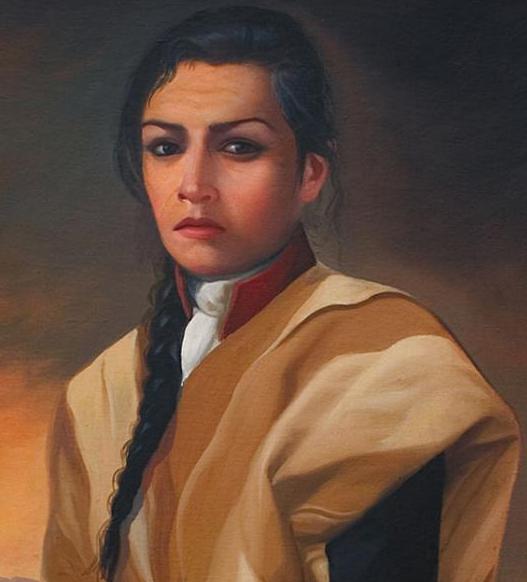
There is only one word for heroine of Bolivian independence Juana Azurduy de Padilla: swashbuckling. Indeed, she seems to have started swashing buckles from a very young age.
After her mother died when Azurduy was only seven, she grew close to her father, who defied the conventions of the age by teaching her to become a skilled rider and sharpshooter. She also went with him to the fields as he worked his land alongside indigenous labourers (highly unusual, since her father was from the Basque country and the Spanish colonisers were not expected to associate on equal terms with the native peoples). This was how she learnt to speak the Quechua and Aymara languages.
But when her father died, Azurduy was sent to live with an aunt, who found her behaviour so challenging she sent her away to a convent. Fellow novitiates remember her worshipping Joan of Arc and proclaiming her own intention to become a liberating warrior.
This was never going to end well. At the age of seventeen she was expelled and returned to live on the family estate. Like her father she maintained close contact with the indigenous people who lived on the estate and saw for herself the abject labour conditions in the nearby silver mines, which inspired her support for the nascent revolutionary movement.
In Manuel Ascencio de Padilla, her childhood friend and neighbour, she found a man who shared her views, and they married in 1805. They fought shoulder to shoulder for the cause of Bolivian independence for the rest of Padilla’s life.
They were the ultimate guerrilla power couple. Each was captured at some stage and rescued by the other. Also, Azurduy was a phenomenal recruiting officer, inspiring through her example and her rhetoric indigenous people, including the women who became known as the Amazonas, to join the movement.
During the battle at Pintadora in 1815, Azurduy was obliged to leave the scene to give birth to her fourth son – but returned to the front line within hours to rally her troops and lead them to victory.
These and other acts of derring-do (such as routing the Spanish forces and seizing their cache of ammunition and weapons) led to her receiving the formal title of Lieutenant General in August 1816. But less than a month later her husband was captured and beheaded. Though she led a counterattack to recover his body, Azurduy was now alone and pregnant with her fifth child in territory occupied by hostile forces.
Undaunted, she fled to Argentina and fought for the revolutionary government there, which appointed her commander of its northern army, meaning she was in charge of over 6,000 men.
When the Spanish finally withdrew from Upper Peru in 1825, she was able to return to her home town, now named Sucre, and was granted a colonel’s military pension by Simon Bolivar’s government. Thirty years later, it was revoked, and she died a pauper, buried in a communal grave.
Only in the 1960s was she ‘rediscovered’: her remains were exhumed and buried in a mausoleum, a Peruvian province and the airport in Sucre were named after her, and Argentine president Cristina Kirchner commissioned a monument to her that was unveiled in 2015.
Which is great. But if she could come back to visit the silver mines whose working conditions gave rise to such revolutionary fervour in her, I think she would be dismayed. Over two hundred years later men (and, since the pandemic, women eager to put bread on their families’ tables) continue to risk their health in return for a pittance, extracting the minerals that fuel the vast profits of the tech giants.
What an absolutely amazing Dame although the last paragraph is depressing. South American history holds so many stories hidden away and untold.
Thanks for sharing this heroine’s story.
Thanks! Yet again I wonder why she isn’t better known . . .