
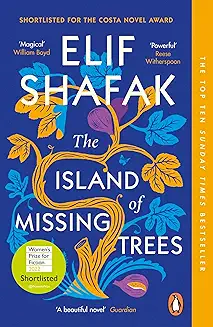
The Island of Missing Trees
Elif Shafak, Penguin
It is not often that my entire book group finds itself out of step with critical opinion (though differences of opinion within the group are frequent). The last time it happened, some years ago, was with a book by a Nobel Prize-winning Icelandic author. AS Byatt deemed his book ‘humane’; we all found it terminally boring – so what did that make us?
This time it’s a book that comes garlanded with praise from Ian McEwen, Mary Beard, Lemn Sissay – and Margaret Atwood, no less – but we found it deeply flawed and unsatisfactory in many ways (and we haven’t even got a Booker between us to validate our opinion!).
The Island of Missing Trees is essentially a love story across national boundaries, as Greek Cypriot Kostas falls in love with Defne, a Turkish Cypriot girl, in the run-up to the coup in 1974. The island is divided in two, and the lovers can no longer conduct their clandestine relationship. Kostas’s mother sends him to Britain for his own safety, unwilling to lose a second son to the hostilities. Two decades later, Kostas goes looking for Defne, and finds her. But of course they are not the same people – too much water has flowed under the bridge.
Central to the narration is a fig tree that grows at the tavern where the lovers meet. Kostas is able to rescue a cutting from the fatally damaged tree and nurture it into life in London. The tree’s continuing consciousness makes it an ideal omniscient narrator – able to fill in the gaps when there are events that Kostas and Meryem either did not witness, or were not in a position to interpret accurately.
I gather from a recent edition of Melvyn Bragg’s In Our Time on Radio 4 that ‘panpsychism’ – the theory that all matter has a measure of consciousness – is a thing. Thankfully for us, the fig tree has an extraordinarily developed level of consciousness.
You would of course expect it to have a firm grasp of the history of Cyprus that it can fill us in on, but this ficus carica goes way beyond that. All manner of creatures visit the tree and confide in it. By the time a mosquito lands on it – in yet another extraordinary coincidence – and recounts her memory of biting one specific infant many years previously, my suspended disbelief was losing its elasticity, and I was not the only one who felt this.
By the end of the book the central love story has buckled under the weight of the treatises on Cypriot history; the life cycles of bees, ants and mosquitoes; the communication and survival mechanisms of trees; the work of the Committee on Missing Persons on exhuming human remains in conflict zones and identifying missing persons from them; and much else besides…
The Island of Missing Trees is an enjoyable enough read, and Shafak excels in conjuring up the landscapes, sounds and smells of Cyprus – and the truculent rudeness of a London teenager. Her themes of separation, migration and love lost and found are at times handled movingly, but at others they are submerged in the overambitious fragmentation of the narrative.
I always value your opinion, Verity. I will put this on my list of books to read mindful that I will probably be in full agreement!
Thank – I hope you enjoy it, despite its flaws!